
Don’t Do More. Do Enough.
The limiting factor in most training programs is not the absence of more work. It is the absence of better work.

There is a prevailing mindset that more sets, more exercises, and more days in the gym produce greater results. This may serve to keep you busy but it wont help you achieve more progress in less time.
The key ingredient missing from the majority of programs is sufficient intensity, not frequency or volume.
How Did We Get Here?
The “do more” mindset has three sources that reinforce each other:
Quantity bias.
Modern mindsets equate total volume of effort with quality of effort. Doing more feels productive and signals that you have a level of commitment and discipline. Doing less (even when more effective) carries the social risk of appearing like you lack the ability to grind as hard as your counter parts or aren’t willing to push yourself to endure.
Equating Soreness with Progress.
Fatigue and soreness are the receipts for satisfactory work to the standard gym-goer. In reality, soreness is an insufficient signal of adaptation, but rather just a phenomenon around muscle damage, productive or not. Generating muscle growth or improving strength requires a specific stimulus, of which, soreness may not be tied to or needed. Soreness is not mandatory nor is it any way aligned to a state of linear progress.
Advice built for drug-assisted athletes.
A growing portion of mainstream fitness advice and programming considerations originate in environments where anabolic drugs are in use. Drug-assisted lifters recover faster and synthesize protein more readily, thus making the case that more volume can be handled and effectively utilized. That same volume applied to a drug-free lifter produces diminishing returns in comparison. Once exogenous drugs become part of the equation, the training considerations change to meet the super-normal recovery capabilities and the increased sensitivity that supports muscle growth while on the drug regimen.
What Actually Drives Strength and Size
The stimulus for growth is mechanical tension. To grow a muscle, it must exert force while placed under load and taken close to failure.
The simple recipes for achieving these adaptations are as follow:
For strength:
80–90% of estimated 1-rep max
1– 3 reps
~3 – 5 working sets
For hypertrophy:
65–85% of estimated 1-rep max
4 – +10 reps
~2–3 working sets
In both cases: The lifter will engage with a high degree of effort, high muscular contraction strain, and reach a condition where there are few to no reps / repeatable efforts left in the tank.
Intensity is the primary variable that dictates how hard a muscle is contracting against an external load. Volume enters the equation as a secondary variable to ensure you reach a near-enough proximity to a satisfactory stimulus. Thus being, intensity creates the stimulus to derive change and volume supports getting close enough to the target. Without satisfactory intensity, the volume is ineffective (commonly called “junk volume”) and fails to drive meaningful adaptations in strength or size.
Volume Has It’s Place
While intensity (mechanical tension and proximity to failure) remains the dominant driver when the goal is pure strength or muscle growth, the equation flips when the objective shifts to other athletic qualities. In these contexts, volume becomes the primary variable for progression. It provides the repeated, accumulated exposures needed to drive adaptation without requiring maximal loads or near-failure effort.
There are three primary areas where volume of work is the key driver of progression:
1.) Speed Sets to Develop Rate of Force Production (RFD)
Dynamic speed work—whether explosive barbell lifts at 30–60% 1RM, medicine-ball throws, or sprint accelerations—deliberately caps intensity to preserve velocity and power output. The stimulus comes from how explosively each rep is performed. To create meaningful changes in RFD, you need a higher number of quality exposures—typically 8+ sets (often 6–10+ sets of 1–3 reps) per session. This gives the nervous system enough high-quality repetitions to reinforce faster motor-unit recruitment. The limiting factor is not to work against fatigue but to prolong high quality outputs. Once bar speed or movement velocity drops noticeably, the set is over. Fatigue is strictly managed with long rest intervals so every rep stays explosive.
2.) Conditioning Work That Builds Metabolic Capacity
Metabolic conditioning is fundamentally a volume-driven process by design. The goal is to improve the body’s ability to produce, tolerate, and clear metabolic byproducts while sustaining power output. This requires you to accumulate work against accumulating fatigue. Progressive overload here almost always means more total volume: longer intervals, more rounds, or reduced rest. A single brutal effort won’t build the same capacity as repeated bouts that repeatedly challenge the fatigue-management systems. Volume is the progression mechanism because the adaptation is built on surviving greater and greater amounts of work.
3.) Building Technical Efficiency at a Given Load
When the target is skill acquisition (grooving technique on a squat, refining sprint mechanics, or perfecting a clean pull at a specific load) intensity is intentionally limited to keep the movement crisp and repeatable. You stay well away from failure so form doesn’t break down. In this scenario, volume becomes the primary way to progress: more total repetitions equal more practice trials, more feedback loops, more confidence, and stronger motor patterns. The cap on progression is still quality and fatigue management (too much accumulated fatigue erodes technique) but within those guardrails, adding volume is how you build technical proficiency.
In each of the above cases, the intensity is capped or gated by a specific constraint, and this pushes total exposures to become the primary means of progression. Even still, volume has its limits as an effective marker; at some point there has to be more weight or more intensity to raise the ceiling of ability. Volume-dominant training is always relative to some current ceiling of ability, which must rise in order for new relative sub-maximal efforts to remain valuable tools.

How Excess Volume Blocks Progress
Doing too much has it’s consequences. Far from simply being inefficient, too much volume actively sabotages gains by compromising the quality of the training stimulus and the body’s recovery processes. The result is less effective workouts and slower (or stalled) progress despite putting in more work.
1.) Systemic fatigue impairs muscle recruitment.
Generating mechanical tension requires high-threshold motor unit recruitment. Fatigue directly impairs that capacity and would hamper the signal to create necessary tension. A fatigued lifter cannot physically reach the loads needed to produce an adaptive stimulus for strength or growth. Instead, the lifter creates conditions for the muscle to adapt to being fatigued, rather than adapting to contracting with more force. While a valuable aspect in conditioning-focused training, it misses the mark when strength and size are the primary outcomes.
2.) Recovery capacity gets overwhelmed.
Growth happens during recovery, not during training. In circumstances where someone is training with excessive volume, the muscles take on more damage than the body can efficiently repair. Instead of rebuilding above the previous baseline, the body is occupied managing accumulated damage. This is a very common case, especially when diet is poor and insufficient to support the demand for recovery. High training volumes effectively dig you too deep into a need to recover that progress flatlines. The more this lifter pushes this condition, the less growth they achieve and eventually stall or backtrack as a result of a persistent recovery debt.
What enough actually looks like
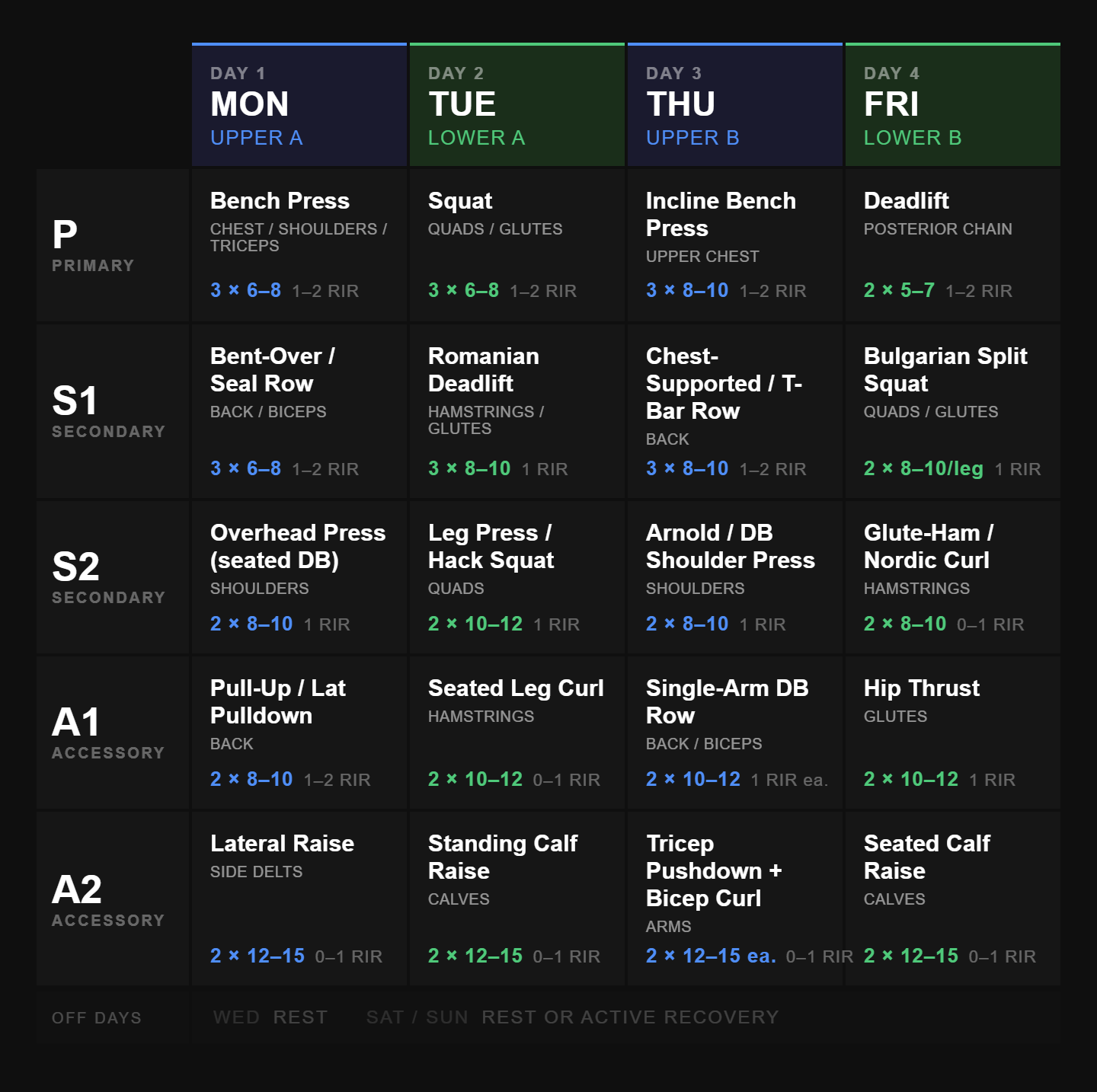
Here is a rough outline of the bare minimums you can realistically apply.
Primary exercises: 2–3 hard working sets
Secondary and accessory exercises: 1–2 hard working sets
Per muscle group or movement pattern: 6–10 effective sets per week, trained 1–2x per week
The case for doing less is not an argument for going easy. It’s an argument for doing what works. Intensity is the key variable that produces strength and size. Volume supports it, but cannot replace it. More sets, more exercises, and more days do not compensate for insufficient effort on the sets that actually matter.
Train hard on fewer things. Recover. Repeat.
That sequence, applied consistently over time, will outperform any program built on the assumption that more is always better.
This is helpful. Thank you.